The statistics lab that runs on your machine.
Statios puts a full Python statistical engine — 600+ analyses, from t-tests to Bayesian regression, SEM and econometrics — directly inside your browser. No installation. The engine runs entirely on-device — your data is never uploaded.
installable as an app on desktop & iPad · works fully offline
Don't take our word for it.
Watch it work.
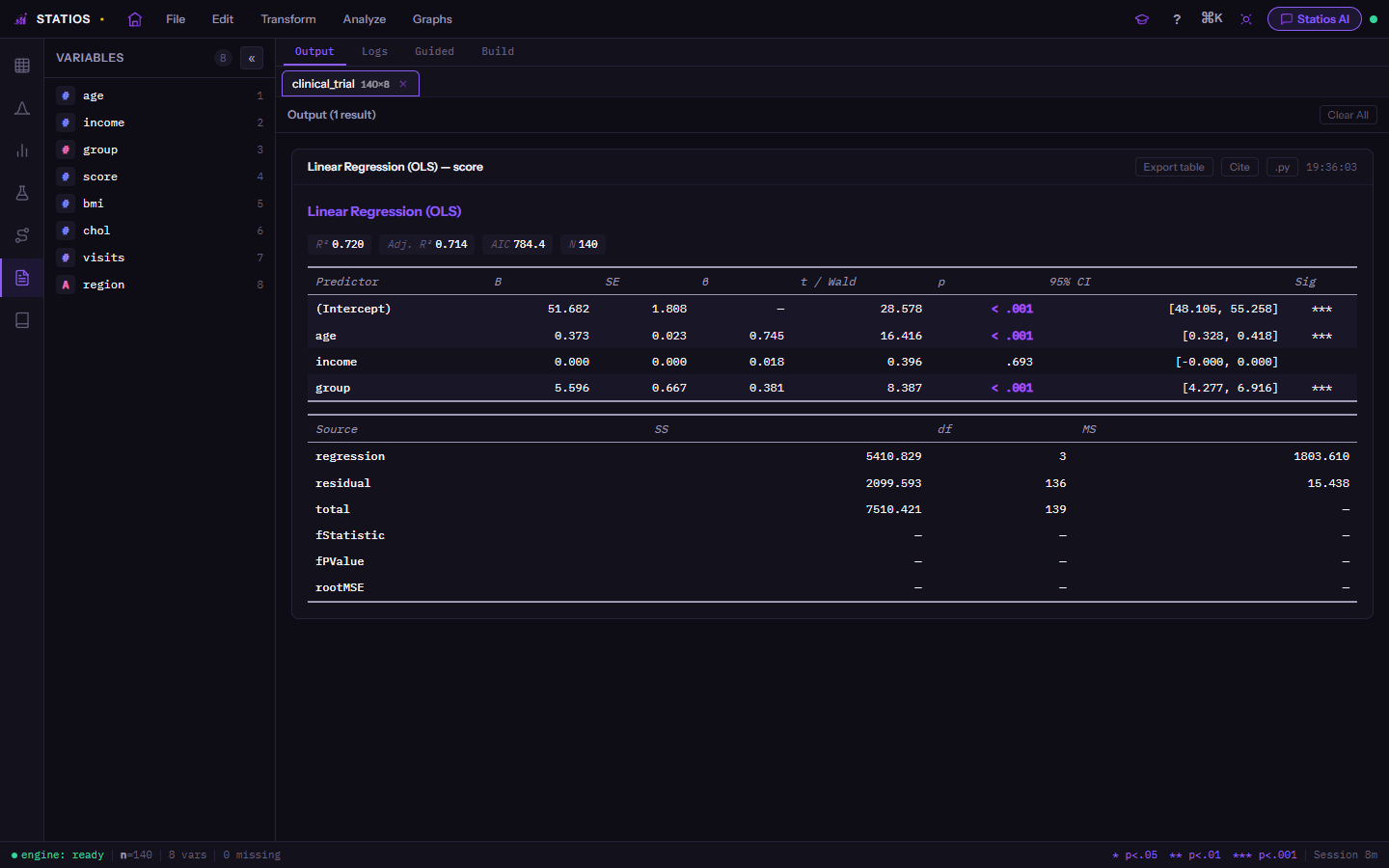
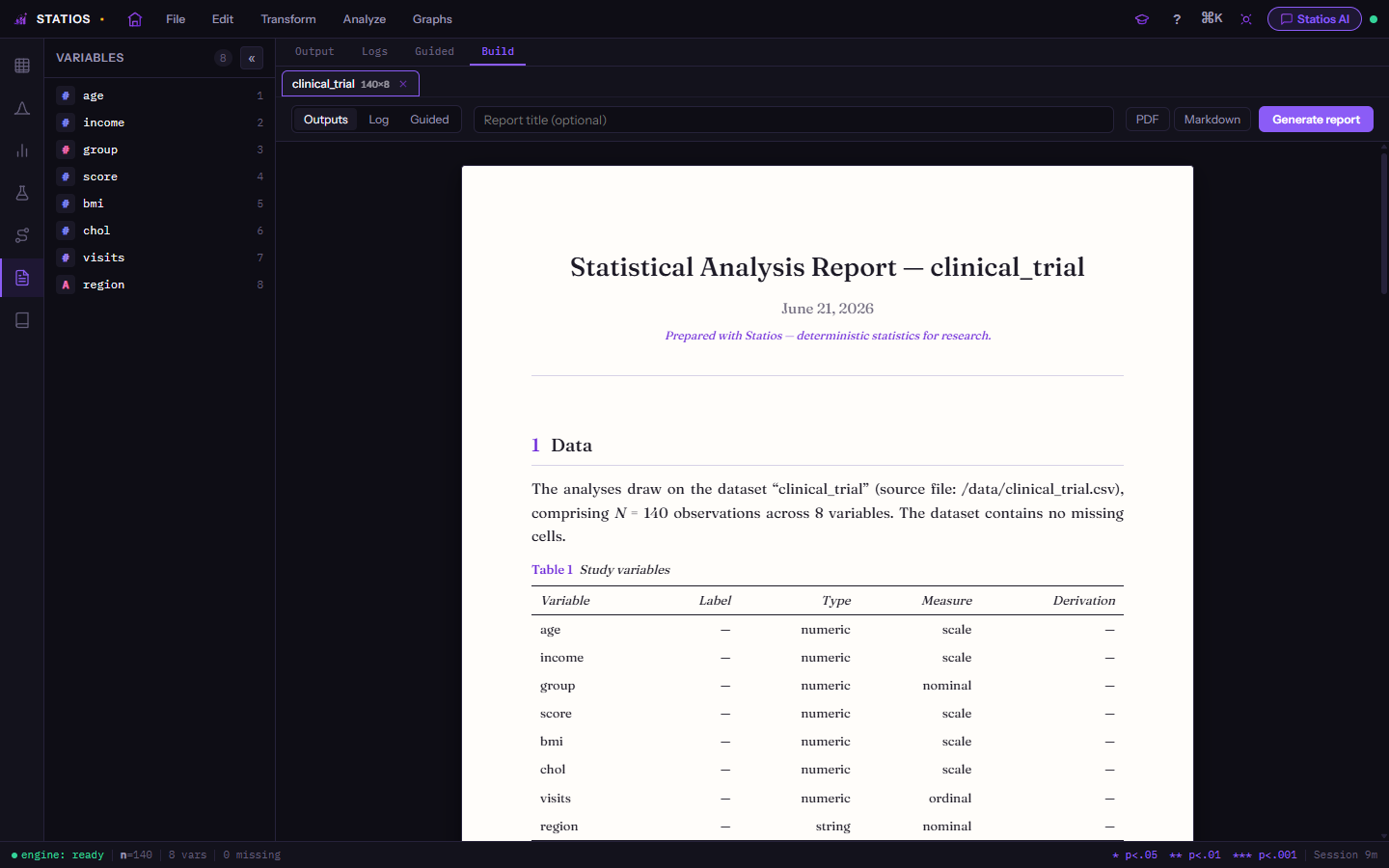
A visual tour of the real app — the data engine, 600 cited procedures, the literature-grounded Auto Researcher, reproducible code and publication-ready reports. Every frame captured live, running entirely in the browser.
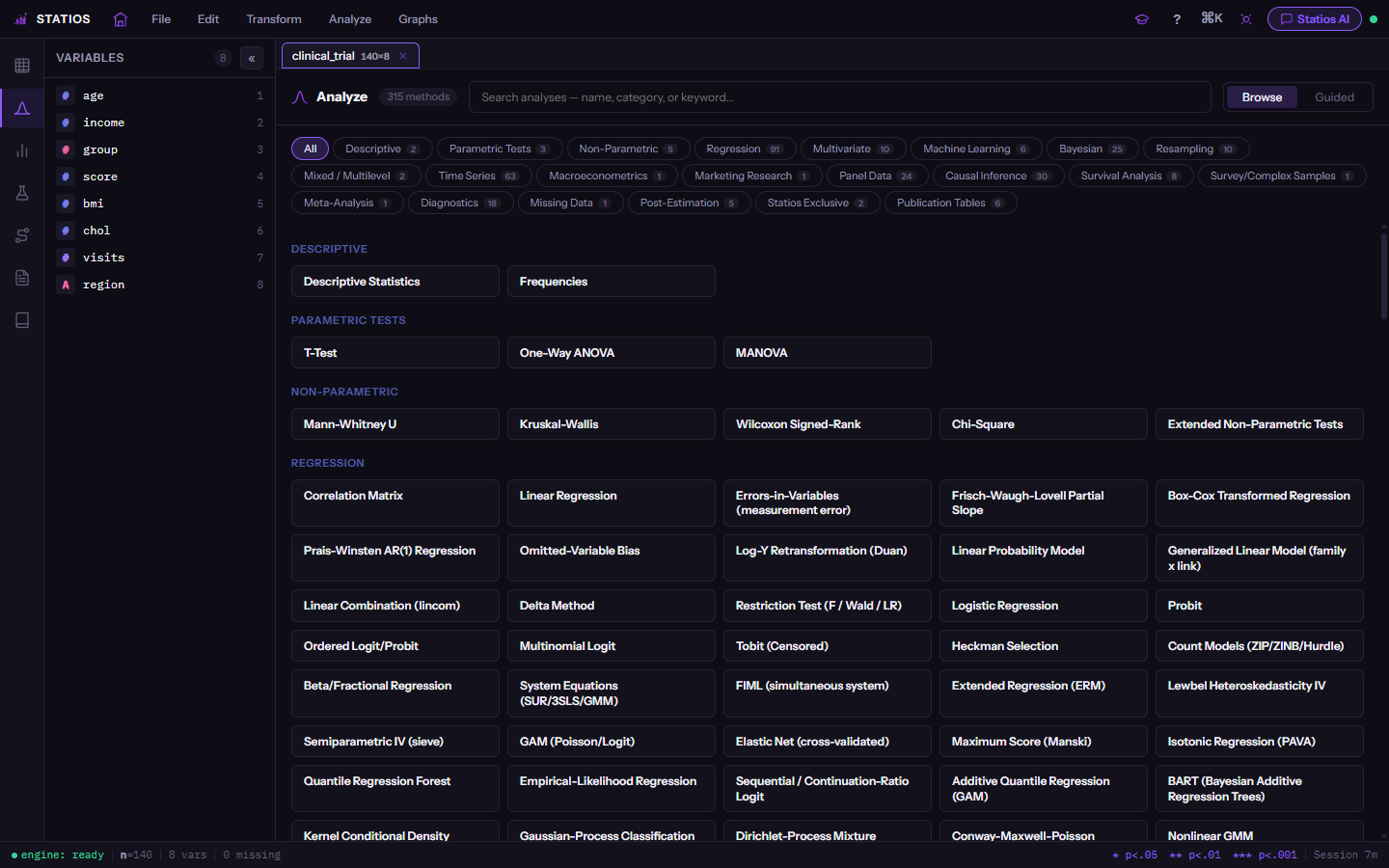
We didn't put statistics in the cloud.
We put the engine in the browser.
Statistical software has always made you choose: install heavyweight desktop suites, or upload sensitive data to someone's server. Statios compiles a complete scientific Python stack to WebAssembly — the same NumPy, SciPy and statsmodels trusted by researchers everywhere — and runs it inside the page you're looking at.
Your rows never leave
Not "encrypted in transit". Not "we promise". The statistical engine loads, analyses and stores your dataset on your device — your raw data is never uploaded. When you use the AI, it sees your variable schema and computed results, never your data rows. Ideal for clinical, student and proprietary data.
One link, every device
Open statios.ai, sign in with a free account, and you have the full lab — or install it as an app on Windows, macOS, Linux and iPad. After the first visit it works entirely offline: field work, flights, hospital basements.
Fast, unmetered
Computation runs right on your machine — typical analyses on datasets of a few hundred thousand rows return in well under a second, and the engine handles tables into the millions. No uploads to wait for, no server queues, no usage caps on local compute: run a thousand analyses a day and the engine never asks for more.
Every result arrives cited —
and the engine is validated against R.
Statistics you can't defend is statistics you can't publish. Every analysis in Statios returns with the methodological references behind it — ready for your bibliography — and the numerical engine is validated against R, the academic gold standard, across 220+ analyses pinned in our test suite at explicit tolerances.
| source | ss | df | f | p | η² |
|---|---|---|---|---|---|
| department | 4.218e9 | 4 | 23.847 | < .001 | 0.166 |
| residual | 2.121e10 | 480 | — | — | — |
| assumptions · levene p = .312 ✓ · shapiro-wilk p = .089 ✓ · tukey hsd attached | |||||
Fisher, R.A. (1925). Statistical Methods for Research Workers. Oliver & Boyd.
Tukey, J.W. (1949). Comparing individual means in the analysis of variance. Biometrics, 5(2).
✓ validated: ANOVA output is pinned against R 4.5.3 aov() on a committed golden-fixture suite.
The AI never does the math.
The engine does.
Ask questions in plain language — the AI translates them into real engine calls and the numbers come back from validated code, never from a language model's imagination. Every figure in the chat is a figure the engine actually computed.
Meet Statios — the AI built in
One assistant, zero setup. No API keys, no accounts to connect, no model menus — Statios will simply be there, powered by frontier models we route per task type, so every researcher gets the same quality of help. Prompts and result summaries go to a thin Statios relay; your raw data rows do not.
- It just works — open the app, ask; nothing to install or configure
- Consistent for everyone — same model quality whether it's your first day or your thesis deadline
- Privacy by design — the relay receives your variable schema and computed results, never your raw data rows, which stay in your browser (enforced server-side)
From question to cited paper —
it runs the study for you.
"Which test should I run?" is the question that blocks most researchers — and an LLM's answer isn't academically defensible. The Auto Researcher interviews you about your study; a versioned knowledge base of decision rules extracted from published methodology literature chooses the methods; then it executes the plan step by step — reading each result, drawing the conclusion, adapting the next step, and flagging when the data can't support a claim — and writes it up as a fully cited paper.
How it stays defensible
- 70 decision rules curated from 91 methodology sources — textbooks, tutorial papers, statistical guidelines — each rule annotated with its references
- Deterministic planner — same study profile, same plan, every time; testable, versioned, reviewable by your supervisor. The AI never chooses the methods; the rules do.
- Reads its own results — it interprets each step, decides the next move, and adapts the plan the way a methodologist would, not a chatbot
- Knows when to hold back — checks whether the data can actually support each test (sample size, power, distribution) and marks a finding demonstrative, not reliable rather than overselling it
- Writes the paper — a cited, APA-7 write-up (Methods, Results, honest Limitations) exportable to PDF, LaTeX and Word
- Where the literature disagrees, Statios shows both defensible arms — never false unanimity
Depth you'd expect from five tools.
In one.
Native .sav (SPSS), .dta (Stata), Excel, CSV and TSV — read and written, in the browser.
What's real today,
and what's next.
RUNNING TODAY
- 600+ analyses fully in-browser, with 220+ of them cross-validated against R 4.5.3 in the test suite
- Statios — the built-in AI: zero setup, consistent frontier quality for everyone
- Auto Researcher — interviews you, plans from the methodology literature, runs the study step by step, and writes a cited paper
- Report Builder — your quantitative process as one cited document, exportable to PDF, LaTeX & Word
- Statistics Wiki — PhD-depth, plainly written, fully cited (315 articles)
- Accounts & sign-in
- Excel-style formulas & SPSS value labels
- Research Path, 37 chart types
- SPSS/Stata/Excel/CSV in & out · offline PWA
IN DEVELOPMENT
- Cloud projects — encrypted sync across your machines (Pro; manual push/pull today)
- Desktop & iPad apps — signed native builds, launching soon
- One-click typeset PDF — server-side LaTeX for the Auto Researcher's papers
- 30+ further methods — built, landing in upcoming releases
- Expert review round with academic partners
PLANNED
- Spatial econometrics — archived for now, planned to return
- Team workspaces & shared projects
- Optional cloud compute for very large jobs — local stays the default, always
Prefer it in its own window?
Statios installs as a native desktop app on Windows, macOS and Linux — the full lab, the same in-browser engine, your data still never leaving your machine. Signed builds are launching soon.

Statistics worth defending.
Statios is in open beta. Join the researchers, students and analysts helping shape it — tell us a little about your work and we'll bring you into the testers.
hello@statios.ai